
What is the chain of title?
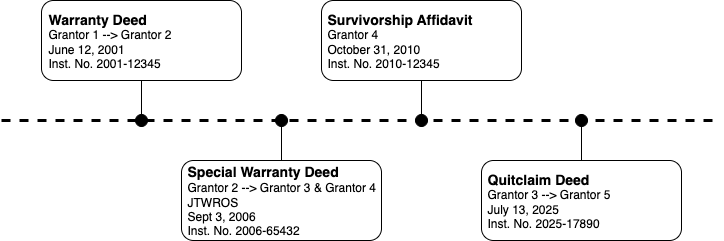
The chain of title is the public record of legal documents showing who owned a property at different times. It includes property deeds, court orders, probate transfers, and other documents affecting title. These documents link together to form a “chain” connecting each owner to the next.
What is the chain of title’s purpose?
The chain of title’s purpose is to prove property ownership. Real estate attorneys and title companies rely on the chain of title to establish ownership.
Title insurance requires a clear chain of title. Before issuing a title policy, the insurer hires a title examiner to review the chain of title (title search). If the examiner finds a clear chain of ownership free from title defects, title is considered “good” or “clear.” Otherwise, the title defect creates a “cloud” on title that must be fixed, or “cured.”
If a title search identifies title defects, real estate attorneys use corrective deeds or court actions to cure them. Common legal actions include:
- Quiet title actions asking a court to determine who owns property and resolve any competing claims
- Probate proceedings to clarify who inherited property from a deceased owner and whether the deceased owner’s creditors may assert a claim against the property
These legal proceedings clear up ambiguity in the chain of title and establish marketable title (title that a reasonable buyer would accept).
1. A clean chain reads like a linked story—each new deed begins where the last one ended. Any name discrepancy, skipped conveyance, or altered description breaks that chain and invites a title defect.
When you review, think like a title examiner: the test isn’t whether the deed “looks right,” but whether every link in the chain connects without assumption.
Consistency with prior chain of title
o Names
o Identity of parties
o Changes explained
o Same legal description
Update cross reference to prior instruments (book/page or instrument number)
Title examiners treat this as a checklist for confirming that the new deed correctly follows the prior record.
Grantor’s Ownership
Confirm that the grantor in the new deed is the same person or entity who took title in the vesting deed.
The grantor’s name in the new deed must be an exact match to the name used in the vesting deed. If the name differs (e.g., “John A. Smith” vs. “John Smith Jr.”), the new deed should include an explanatory recital (e.g., “John A. Smith, being one and the same as John Smith Jr.” This ensures that the chain of title is unambiguous.
If the grantor is a business entity—for example, a corporation, real estate LLC, or family limited partnership—verify spelling, punctuation, and identifiers in entity names (“LLC” vs. “L.L.C.”). If a company’s structure changed, check for merger certificates or name change filings. Ensure the same version of the name appears throughout the deed and matches the signature block and acknowledgment.
Exact Legal Description Match
The new deed’s legal description should match the one in the prior vesting deed verbatim. Compare lot and block numbers, subdivision names, metes and bounds, and recording book/page references. Note any omissions or additions—like an easement or partial conveyance—and confirm they’re intentional.
Because even minor errors in the legal description can require curative title work, it is best to proofread it with another person to be sure that the legal description in the new deed is an exact match to the legal description in the old deed. See the [Symbols and Directional Abbreviations Used in Legal Descriptions] for an understanding of what words to use when proofreading legal descriptions involving unfamiliar symbols.
Reference to Prior Instrument
Some legal descriptions incorporate the prior conveyance by book, page, or instrument number. The recording office uses this to index continuity in the chain. [Describe how to update these information if needed].
Title Encumbrances and Exceptions
Review prior deeds for covenants, conditions, and restrictions (CC&Rs) or easements that must appear or be acknowledged in the new deed. Check whether prior mortgages or liens remain of record and whether they need to be released before or concurrently with the new deed.
Consistent Property Identifiers
Verify that parcel IDs, tax map numbers, and situs addresses align with county records and the legal description. These identifiers must track seamlessly through the chain to prevent mismatched indexing.
Where are deeds and other title records located?
In most U.S. states, the county where property is located maintains the public records that form the chain of title for that property. The recording office stores these records in two ways:
- Physical record books. Traditionally, deeds and other real estate documents were kept in bound volumes at the county recorder’s office, clerk of court, or register of deeds. Many counties still maintain physical records.
- Digital archives. Most counties now scan and store deeds, mortgages, and other title-related documents in electronic systems.
Most counties allow attorneys and title companies to record title documents electronically (e-recording) and provide the records to the public through an online portal. Some rural counties are still digitizing public records, but the transition is steadily progressing.
What is a county-equivalent jurisdiction?
The U.S. Census Bureau uses the term “county-equivalent jurisdiction” to classify jurisdictions that function like counties, but are not organized as counties at the state level. The term includes:
- Independent cities that are legally separate from counties considered the primary legal subdivision in the state
- Consolidated city-counties where the city and the county have overlapping boundaries (for example, San Francisco, California)
- Boroughs in Alaska and parishes in Louisiana
In the continental U.S., most real estate records are maintained in the records of the county where the property is located. But if the property is located in a county-equivalent jurisdiction, that jurisdiction maintains the records.
Independent cities are the most common county-equivalent jurisdictions. Examples of independent cities include Baltimore, Maryland; St. Louis, Missouri; Carson City, Nevada; and 38 cities in Virginia, including Richmond, Norfolk, Alexandria, and Virginia Beach. Each independent city has its own recorder or clerk.
Outside the continental U.S., real estate records are maintained at the state level. The Alaska Department of Natural Resources, Recorder’s Office maintains Alaska land records. The state is divided into recording districts instead of counties. Each district keeps records of property located within that district, but recording is through a single, statewide system.
Similarly, Hawaii has no counties. Hawaii’s Bureau of Conveyances maintains statewide land records. Hawaii uses a dual system: a regular system like other states and a land court (Torrens) system that tracks ownership and issues title certificates.
Who maintains title records?
Each county or other local jurisdiction has an official responsible for maintaining the chain of title. Depending on state law, the official may be called the recorder of deeds, county clerk, chancery clerk, or register of deeds. This official ensures that the chain of title remains public, traceable, and legally reliable.
The recording office maintains the records that form the chain of title, but does not examine the chain of title before recording a document. A clerk’s acceptance of a document does not confirm its validity or effect on property ownership. Recording only confirms that the document meets statutory filing requirements.
Attorney Practice Note: Recording as Evidence of Property Transfer
Many laypeople believe that the clerk’s acceptance of a deed for recording proves that the grantee acquired the property. This is not the case. State law prohibits recording clerks—who are not attorneys—from giving legal opinions about a document’s validity. If the document meets recording requirements, the clerk must record it, even if it is invalid. Only a title search can confirm ownership.